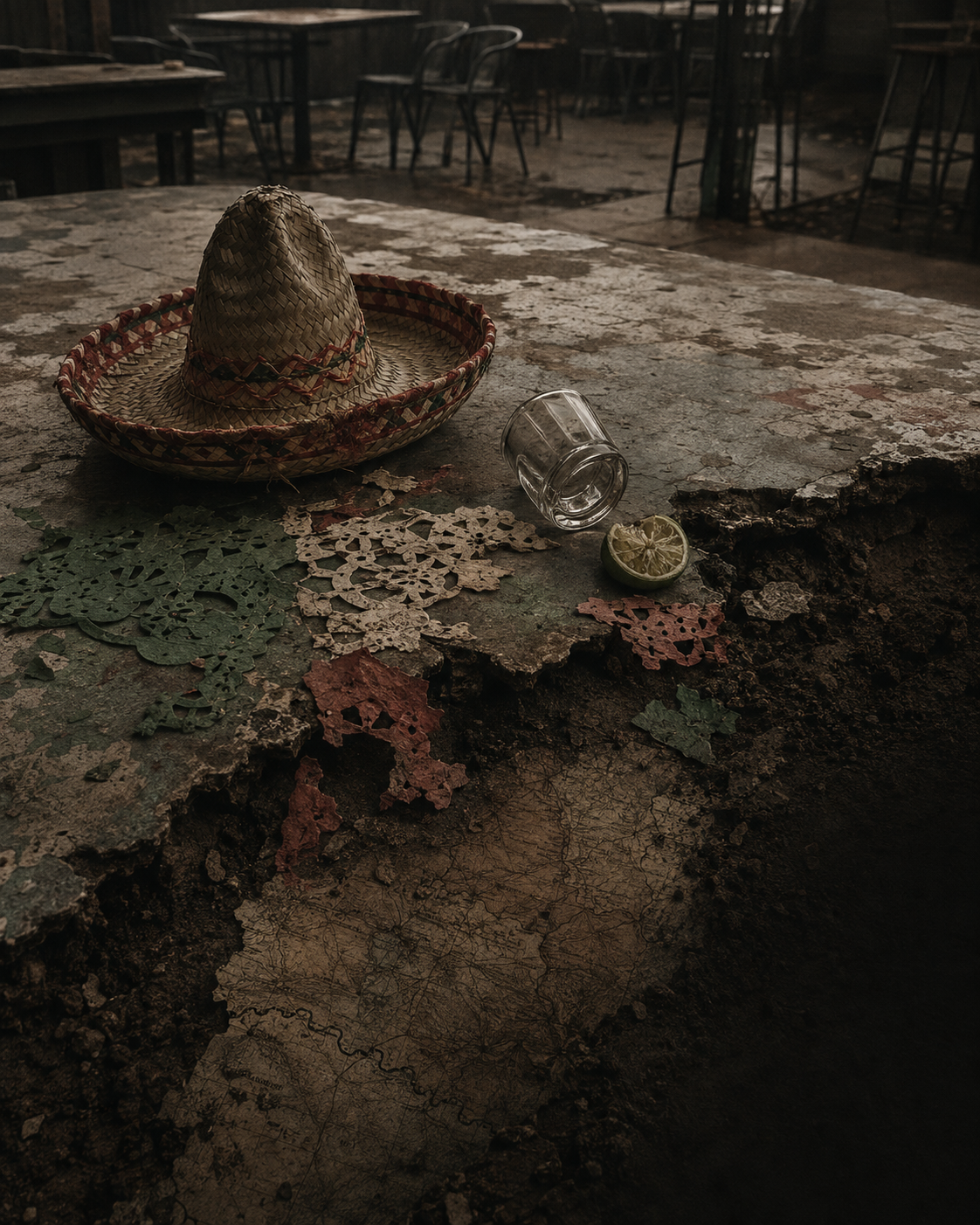
Today, bars across the United States will fill with people wearing sombreros they did not earn, drinking tequila they do not think about, and celebrating a holiday they do not understand.
Cinco de Mayo, contrary to popular (U.S.) belief, is not Mexican Independence Day. It commemorates the Battle of Puebla, a moment of resistance against French imperial forces in 1862. In Mexico, it is a relatively minor holiday, observed most prominently in the state of Puebla. In the United States, however, it has been transformed into something else entirely. Not remembrance. Not even solidarity. But spectacle.
That transformation did not happen by accident. It was cultivated, marketed, and expanded, particularly in the late twentieth century, as corporations recognized the commercial potential of a vaguely defined “Mexican” celebration. What emerged is a familiar pattern: culture stripped of context, repackaged for consumption, and sold back as entertainment.
What makes this moment worth sitting with is not simply the inaccuracy. It is the dissonance.
Because the same country that enthusiastically consumes a flattened, festive version of Mexican identity is also one in which anti-Hispanic sentiment remains pervasive, where immigration is framed as threat, where Spanish spoken in public can still provoke hostility, and where entire communities are subjected to suspicion, surveillance, and policy violence. Celebration and exclusion are not contradictions here. They are coexisting features of the same system.
This is not new. The selective embrace of culture alongside the rejection of people has a long history in the United States. Food, music, language, aesthetics, all can be welcomed, even fetishized, so long as they remain detached from the individuals and communities that produced them. What is consumed is the idea of culture, not the lived reality of those who inhabit it.
If you have been listening to this podcast, you already know where this leads me. Landscapes remember. Not just the dramatic moments of conflict, but the quieter, ongoing processes that shape who belongs and who does not. The neighborhoods where Mexican and Mexican American communities are concentrated. The agricultural fields where labor is rendered invisible but indispensable. The borderlands where policy becomes physical, where lines drawn on a map are enforced on bodies.
Cinco de Mayo, as it is widely observed in the United States, is part of that geography. Not because of what it claims to celebrate, but because of what it reveals. It shows how easily history can be emptied of meaning and refilled with something more palatable. It shows how consumption can stand in for understanding. And it shows how a nation can, in the same breath, celebrate a culture and marginalize the people who live it.
I am not interested in telling anyone not to celebrate. But I am interested in asking what, exactly, is being celebrated, and at whose expense.
Because if the land remembers, so do these moments. And they tell us less about Mexico than they do about the United States, about what it chooses to honor, what it chooses to ignore, and how those choices continue to shape the world we move through.