Every July Fourth, we celebrate freedom by buying things, burning things, and blowing things up.
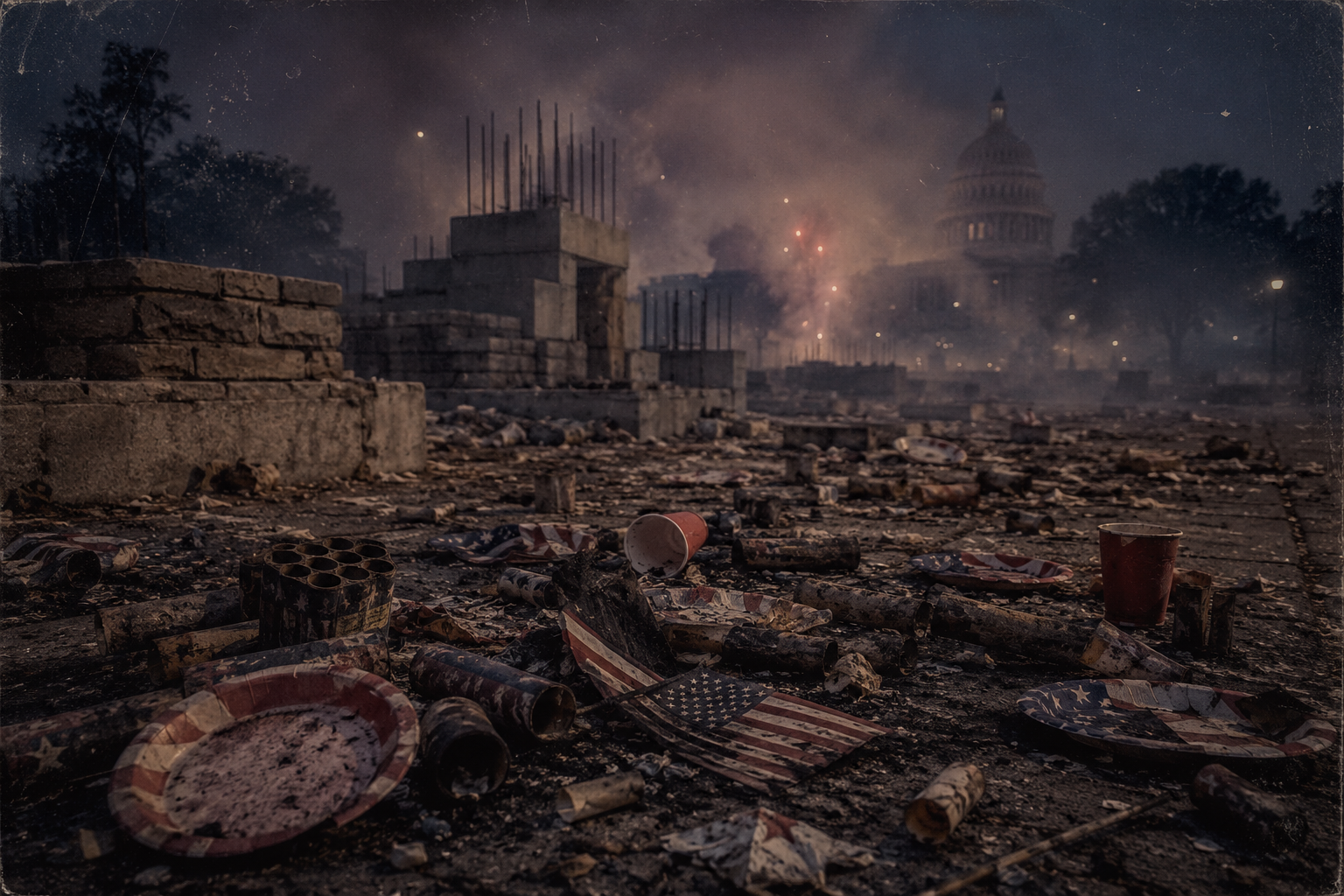
We cover our tables in disposable plates, plastic cups, and food that may or may not be eaten. We buy flags, clothing, decorations, and explosives, often manufactured by workers whose own freedom is sharply constrained, and turn the night sky into a brief theater of noise and light. By morning, streets and yards are littered with the remains.
It is an oddly appropriate ritual for the United States: spectacular, expensive, wasteful, and over almost as soon as it begins.
Admittedly, the fireworks are beautiful. That’s part of their power. They demand our attention while requiring very little reflection. For a few minutes, freedom becomes something we can see and hear. Something flashy and loud enough to drown out any difficult questions about what freedom means, who possesses it, or who pays for its performance.
This preference for spectacle over substance isn’t new. It was present at the nation’s founding.
For instance, the Boston Tea Party remains one of the best-known episodes of the American Revolution precisely because it was such effective political theater. Men disguised themselves as Indigenous people, boarded ships, and destroyed a valuable commodity in protest against taxation without representation. It was dramatic, memorable, and easily transformed into a national myth.
But representation for whom?
The colonists who objected to being governed without their consent did not generally extend that objection to the people they enslaved, the women they subordinated, the Indigenous nations whose lands they occupied, or the laborers and servants whose political power was severely constrained. Even the use of Indigenous disguises turned Native identity into a costume while actual Indigenous sovereignty remained an obstacle to colonial expansion.
The performance of rebellion was expansive. Its conception of freedom was not.
The Declaration of Independence soon announced that all men were created equal, even as its principal author enslaved human beings. The contradiction is usually presented as an unfortunate failure to live up to an otherwise universal ideal. But it was more than personal inconsistency. The emerging nation depended upon racial slavery, Indigenous dispossession, unequal property relations, and the political exclusion of most of the people living within it.
The Constitution did not abolish those hierarchies. It reorganized and protected many of them.
It created a republic without creating universal democracy. It accommodated slavery without speaking its name directly. It protected property, constructed powerful institutions insulated from popular control, and left voting qualifications largely to states that restricted meaningful political participation. Women, enslaved people, most Indigenous people, and many poor or propertyless men were excluded from the political community whose freedom the new government claimed to represent.
The Revolution changed who governed, but it left much of the existing social order intact. Colonial elites became national elites. Wealth remained concentrated. Labor remained exploited. Racial hierarchy became embedded in the economic and political structure of the new republic.
The country gained independence from Britain, but most of its inhabitants did not suddenly become free.
This does not mean that the founding language was meaningless. Words and phrases such as “equality,” “liberty,” and “popular sovereignty” created standards that later generations could seize and turn against the institutions that had failed to honor them. But the expansion of freedom did not occur automatically because those words appeared in a founding document.
It happened because people struggled.
Enslaved people fled plantations, resisted their captors, and forced slavery into the center of the national crisis. Abolitionists challenged both the law and the social respectability of human bondage. Workers organized against dangerous conditions, starvation wages, and the unchecked authority of employers. Women demanded political and economic rights that the founders never intended to give them. Indigenous nations resisted removal and erasure. Black Americans fought to create democracy during Reconstruction and fought again when that democracy was violently dismantled. Civil-rights activists, queer organizers, disability advocates, immigrants, and countless others expanded the practical meaning of freedom through collective action.
Nearly every freedom we now describe as characteristically American had to be demanded from an America that initially refused to provide it.
Yet on July Fourth, those struggles often disappear behind the founding fathers, the flags, and the fireworks. Freedom becomes a national possession rather than an unfinished political project. We celebrate as though liberty arrived fully formed in 1776 and has merely waited for each succeeding generation to enjoy it.
This story is comforting because it relieves us of responsibility.
If America is already free, then poverty can be treated as an individual failure rather than as a restriction on human possibility. If America is already equal, then racial and gender hierarchies can be dismissed as remnants of the past rather than structures continuously reproduced in the present. If democracy has already been achieved, then voting becomes proof of popular power even when wealth determines which choices become politically available.
And if freedom is something we already possess, we can celebrate it without having to create more of it.
We can purchase freedom as a flag printed on a T-shirt. We can grill it, advertise it, salute it, and detonate it in the sky. We can consume the image of freedom while accepting lives governed by debt, insecure housing, inadequate healthcare, precarious employment, ubiquitous surveillance, mass incarceration, and political institutions designed to contain popular demands.
The spectacle asks almost nothing of us except participation.
Substantive freedom asks much more.
It asks whether people have the material security necessary to direct their own lives. It asks whether democracy extends into workplaces and economies rather than stopping at the edge of the voting booth. It asks whether political equality can exist alongside extreme concentrations of wealth and power. It asks whose labor makes our celebrations possible, whose land we occupy, whose histories we omit, and whose suffering we have learned not to see.
I am not interested in telling anyone not to celebrate. Joy matters. Gathering with other people matters. Food, music, ritual, and even fireworks can create moments of genuine connection.
But celebration without reflection becomes mythology, and mythology is often used to protect the very arrangements freedom should allow us to challenge.
Perhaps July Fourth could become something more than a birthday party for the state. Perhaps it could also be an annual accounting: a day to measure the freedom promised against the freedom actually available.
That accounting would not require us to deny the progress that has been made. It would require us to remember where that progress came from. Freedom has expanded not because the American political system naturally bends toward justice, but because generations of people organized, resisted, sacrificed, and refused to accept the limits imposed upon them.
There is something hopeful in that history.
The hierarchy preserved at the founding was not permanent. Neither are the hierarchies that remain today. The country has changed because ordinary people forced it to change, often while being condemned as disruptive, unpatriotic, dangerous, or unrealistic.
The work is unfinished, but unfinished does not mean impossible.
Ultimately, we do not honor freedom by pretending it was completed in 1776. We honor it by recognizing the distance between its performance and its substance and by refusing to accept fireworks as a substitute for the harder, slower work of liberation.
The sky will go dark again. The smoke will clear. The debris will remain on the ground.
And so will everything we have not yet changed.