On the first Monday in September, the United States celebrates labor by trying very hard not to talk about labor power.
We grill. We shop Labor Day sales. We mark the unofficial end of summer. Politicians issue statements praising the American worker, a figure sturdy enough to build the nation but apparently too polite to ask who profited from all that building.
The worker is celebrated. The union is usually missing.
In much of the world, labor is celebrated on May 1. International Workers’ Day, often simply called May Day, is not primarily a tribute to industriousness. It commemorates workers as a political force. Its history is bound to strikes, demonstrations, international solidarity, and the demand for an eight-hour workday.
The distinction matters.
Labor Day tells us that work is honorable. May Day reminds us that workers have power.
Those are not the same claim.
The Convenient Story
There is a neat version of this history in which the United States deliberately moved its labor holiday from May to September to separate American workers from a radical international movement.
It is a useful story. It is also too simple.
The first American Labor Day celebration was held in New York City on September 5, 1882, at the urging of the Central Labor Union. Thousands of workers marched through the city and gathered for speeches, music, and a picnic. That happened seven years before an international congress of socialist and labor organizations selected May 1 as a day of worldwide worker demonstrations.
September did not begin as an escape from May Day.
But chronology does not rescue the American holiday from ideology. Dates acquire meaning through the stories we attach to them, the rituals we build around them, and the alternatives we choose to forget.
May Day’s origins are deeply American. On May 1, 1886, workers across the United States struck in support of the eight hour workday. In Chicago, that struggle culminated in the Haymarket Affair, when a bomb exploded during a labor demonstration and police opened fire. Eight anarchists were convicted in proceedings now widely understood as profoundly unjust. Four were executed.
The movement was attacked at home and memorialized abroad.
In 1889, an international gathering of socialist and labor organizations called for May 1 demonstrations in support of the eight-hour work day. Workers around the world began commemorating a struggle rooted in the United States. May Day became an international workers’ holiday, built partly from American blood and American organizing.
The United States kept September.
That separation eventually became more than a difference between two dates. It became a boundary between two ways of understanding labor.
A Holiday in the Middle of a Strike
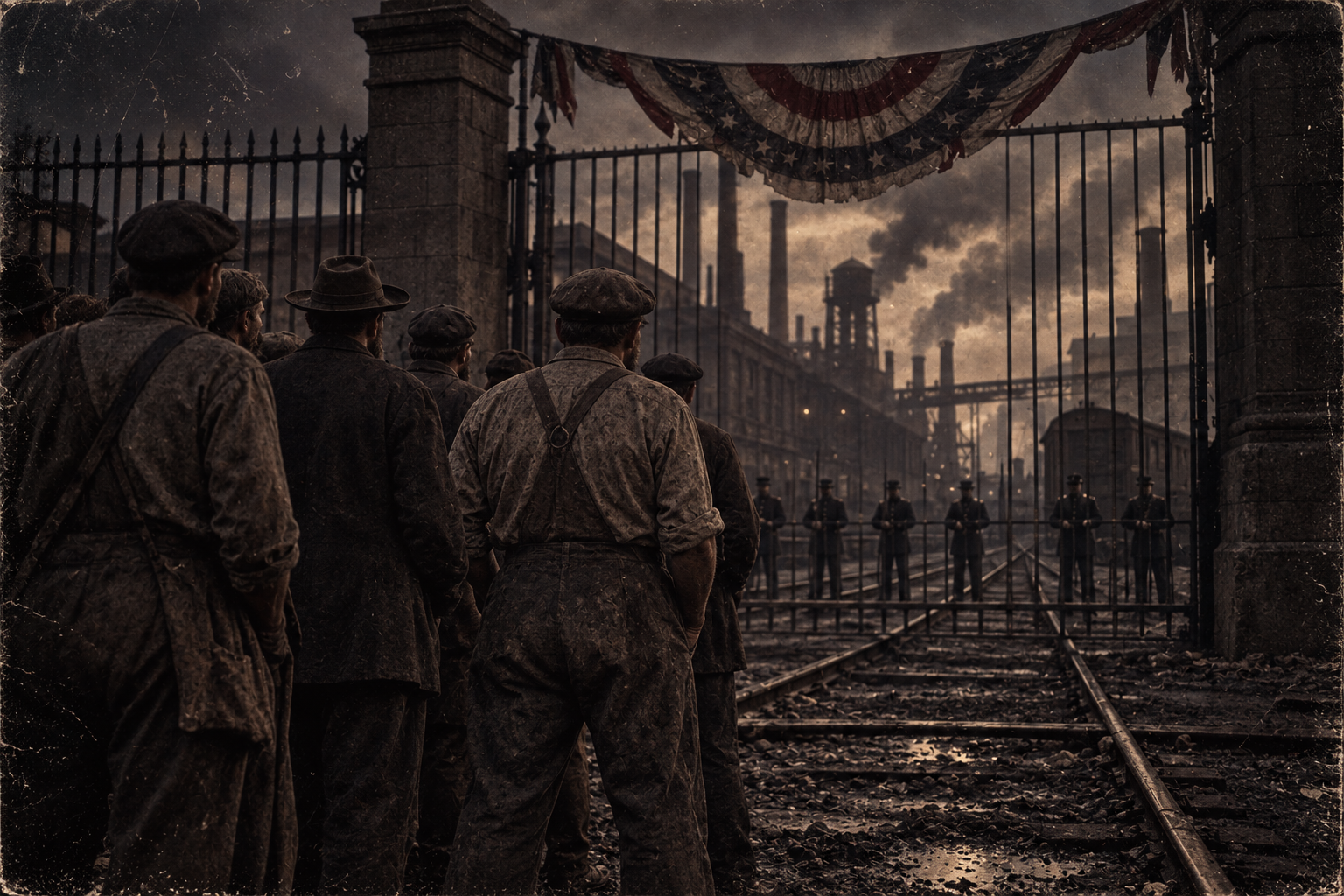
Labor Day became a federal holiday in 1894, during one of the most consequential labor conflicts in American history.
Workers at the Pullman Company lived in a company town outside Chicago. Pullman controlled their jobs, their homes, and many of the services on which their families depended. When an economic depression reduced demand for railroad cars, the company cut wages. It did not make corresponding reductions in rent.
Workers were expected to absorb the crisis. Corporate dividends were not.
The workers struck. The American Railway Union, led by Eugene V. Debs, supported them through a nationwide boycott of trains carrying Pullman cars. The action disrupted rail traffic across much of the country and demonstrated precisely what organized labor could do when workers understood that another worker’s dispute was also their own.
The federal government responded with an injunction. President Grover Cleveland sent troops to protect industrial profit. Workers were killed, Debs was jailed, and the union was destroyed.
In the middle of that conflict, Congress passed legislation establishing Labor Day as a federal holiday. Cleveland signed it on June 28, 1894. Within days, his administration would use federal power to break the strike.
The government honored labor and suppressed labor almost simultaneously.
That contradiction tells us far more about the holiday than any parade or presidential proclamation. Labor could be praised as the source of national prosperity. Workers could be thanked for their sacrifice, endurance, and productivity. What they could not be permitted to do was exercise enough collective power to interrupt the circulation of goods, mail, or profit.
Recognition was acceptable. Disruption was not.
The holiday survived. The boycott did not.
A Safer Kind of Worker
American Labor Day celebrates the worker primarily as a contributor.
The worker builds. The worker produces. The worker perseveres. The worker makes the nation strong.
It is a flattering portrait, provided we do not ask what the worker is owed.
May Day begins from a different premise. It treats workers not merely as contributors to an existing system, but as people capable of changing that system. Its central figure is not the diligent individual employee. It is the organized class.
That is a much more dangerous image.
A worker can be praised while being exploited. Workers acting together, however, can make demands.
This is why separating American labor from international labor has never been merely symbolic. It narrows the field of solidarity. It teaches workers to understand themselves first as Americans, then as employees of a particular company, then perhaps as members of a particular trade. Only after all those categories have been satisfied are they invited to recognize what they share with workers elsewhere.
By then, there may not be much solidarity left.
The ideological boundary became especially explicit during the Cold War. In 1958, Congress designated May 1 as Loyalty Day. On the same date that workers throughout much of the world celebrated international solidarity, Americans were officially encouraged to reaffirm their loyalty to the nation.
The substitution is almost painfully tidy.
May Day asks workers to look across national borders and recognize a common relationship to power. Loyalty Day asks them to look toward the flag. One organizes identity around labor. The other organizes it around the nation.
These identities do not have to be incompatible. But American political culture has repeatedly treated them as though they are. International labor solidarity becomes foreign, radical, or vaguely treasonous. The good American worker is loyal, grateful, and productive. The dangerous worker recognizes that the people signing her paycheck may have more in common with employers overseas than she has with them.
Keeping Solidarity Small
The separation between Labor Day and May Day also mirrors the structure of American labor law.
The law generally channels workers into individual workplaces and carefully defined bargaining units. The 1947 Taft Hartley Act restricted secondary boycotts, one of the most powerful ways workers can support people outside their own immediate dispute. It also allowed states to enact so-called “right to work” laws that weaken unions by permitting represented workers to withhold financial support from the organizations legally required to represent them.
Solidarity is permitted, but it’s fenced in.
Workers may organize, but only through a system that divides them by employer, industry, classification, immigration status, and jurisdiction. Public workers are separated from private workers. Employees are separated from independent contractors. Agricultural and domestic workers were excluded from major federal labor protections from the beginning, exclusions inseparable from the racial politics of the New Deal.
These divisions are legal, but they’re also ideological. They encourage workers to see another group’s strike as an inconvenience rather than an extension of their own struggle.
Employers, on the other hand, understand and leverage the value of coordinated power. Corporations combine, merge, lobby, fund trade associations, share consultants, and move capital across borders with remarkable freedom. Their solidarity is called strategy.
When workers coordinate across workplaces, industries, or national boundaries, their solidarity is treated as coercion.
This is how labor is hamstrung twice. The law restricts collective action, and the culture teaches workers to distrust it.
The results are visible. According to the Bureau of Labor Statistics, only 10 percent of American wage and salary workers belonged to a union in 2025. In 1983, the first year for which comparable data are available, the rate was 20.1 percent.
We did not arrive here simply because Americans became less interested in unions. Employers fought organizing. Legislatures restricted it. Courts narrowed it. Political campaigns depicted unions as corrupt, obsolete, or greedy. Entire industries were reorganized to make collective bargaining more difficult.
The calendar did not cause this decline. But it helps teach the worldview that made the decline possible.
What We Are Allowed to Remember
American Labor Day is not meaningless. Workers deserve a holiday. They deserve rest, celebration, and public recognition.
But recognition is not power.
A holiday can preserve the memory of a movement while removing the movement’s demands. It can praise workers in language broad enough to include everyone and specific enough to obligate no one. It can turn conflict into contribution and collective struggle into national gratitude.
We remember that workers built America.
We are less often invited to remember that workers had to fight America’s employers, courts, police, and government to claim a share of what they built.
The weekend was not a gift. The eight-hour day was not a gift. Workplace safety laws, restrictions on child labor, pensions, paid leave, and collective bargaining rights did not appear because powerful institutions eventually noticed that workers seemed tired.
They were won through organization and disruption.
None of this requires romanticizing the American labor movement. American unions have often reproduced the same racial, gender, and citizenship hierarchies that divided the broader society. The American Railway Union itself refused to admit Black railroad workers, weakening the solidarity on which the Pullman boycott depended. A movement can speak the language of universal brotherhood while deciding that some workers are not brothers.
Internationalism does not automatically produce justice. Neither does unionism.
But a movement cannot become more just or inclusive by becoming less powerful. It becomes more just and inclusive by expanding the meaning of solidarity and by refusing the divisions that make exploitation easier.
Labor Power
The deepest difference between September and May is not the season. It is the object of celebration.
American Labor Day celebrates work.
May Day celebrates workers acting together.
One honors contribution. The other confronts power.
That is why the separation matters. It removes American labor from an international history that began, in part, here. It turns a movement into a holiday and solidarity into patriotism. It gives workers a day of recognition while leaving them increasingly unable to control the conditions under which they labor.
So celebrate Labor Day. Rest, if you are among the workers who are permitted to do so. Go to the picnic. Enjoy the final weekend of summer.
But do not confuse gratitude with power.
A worker praised by an employer can still be fired. A worker thanked by a politician can still be denied a living wage. A worker celebrated by a nation can still be punished for organizing with other workers.
Labor becomes power only when workers act collectively, including across the boundaries designed to keep them apart.
The date is not the injury. The lesson attached to it is.
American workers are encouraged to see themselves as workers only within carefully managed limits. Their solidarity may extend across a break room, perhaps across a workplace, occasionally across an industry. It is not supposed to cross every border that capital crosses without hesitation.
And that is how labor is kept in its place.