Every September, we return to the images.
The planes. The smoke. The people looking up. The streets filling with dust. The faces on photographs taped to walls by people who still hoped someone might recognize the person they loved.
We return to the names, too. We should. Each belonged to someone whose life exceeded the circumstances of their death. Someone with unfinished work, ordinary frustrations, private jokes, and plans for later.
But twenty-five years after September 11, 2001, I find myself asking what our public remembrance requires of us once the ceremony ends.
We say we will never forget.
What have we decided to remember?
And what have we made remembering an excuse to avoid?
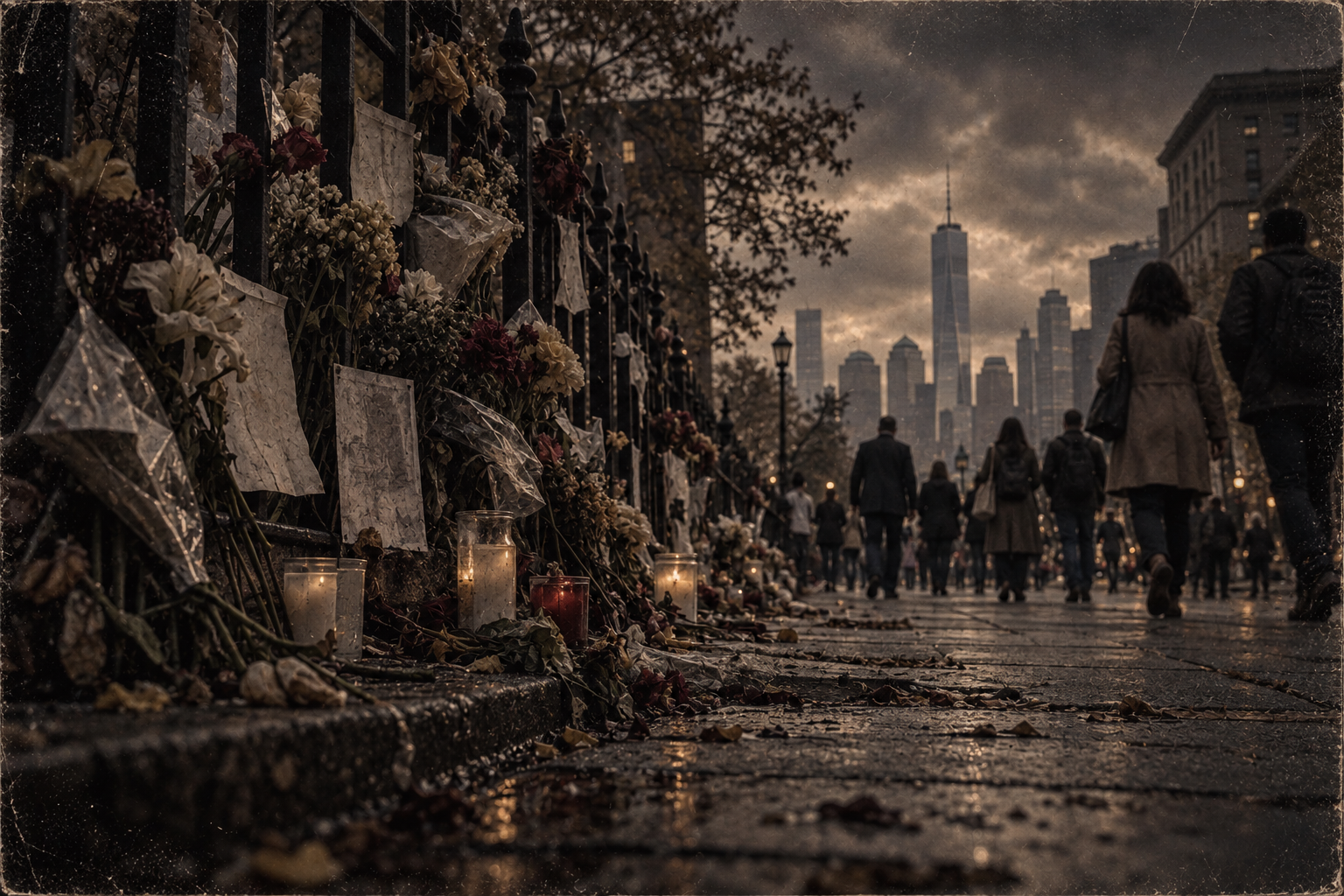
There is a contradiction in the way America mourns New York. The city becomes sacred when it’s wounded. Its skyline becomes everyone’s skyline. Its firefighters become everyone’s heroes. People who have never walked its streets speak of it with the intimacy of home.
Then the anniversary passes, and another familiar New York returns to political conversation: too foreign, too liberal, too secular, too crowded with people who supposedly do not represent the country.
The city we embrace as America in catastrophe becomes un-American when its residents express their values, exercise political power, or insist that they belong.
Why do we love New York in tragedy but struggle to love it in triumph?
By triumph, I do not mean the stock market or the price of Manhattan real estate. I mean the daily achievement of people with different languages, religions, histories, and desires making a shared life. An imperfect life, marked by inequality and conflict, but a shared life nonetheless.
The attacks were reprehensible because human beings were deliberately murdered. That judgment does not depend on anyone’s affection for New York or agreement with its politics. But our declarations of solidarity create an obligation beyond condemning the killers. If we insist that an attack on these people was an attack on all of us, we should be willing to examine who we include in “us” when they are alive.
The September 11 victims came from more than ninety nations. The diversity sometimes treated as a threat to America was among the things America lost that morning.
Washington presents a related contradiction. The Pentagon, across the river in Arlington, became a national wound. Yet Washington as a living place is routinely collapsed into a contemptuous shorthand for government. Its residents disappear behind the buildings. The people who teach children, clean offices, care for patients, and ride buses become incidental to the symbol.
Perhaps that’s part of the answer to the questions I initially posed. After all, a symbol asks less of us than a neighbor.
We can place a flag over a skyline without having to listen to anyone who lives beneath it. We can honor a city’s dead without accepting its living residents as equal participants in defining the nation.
The dead cannot interrupt the speech.
The living can.
This does not make public mourning false. The grief was real, and it remains real. For families, survivors, responders, and people whose health was damaged, September 11 has never been merely an anniversary.
Precisely because the loss is real, its political uses deserve scrutiny.
There is a point at which remembrance becomes a test of obedience. Grief is presented as evidence for a policy. Questions about that policy become evidence of insufficient grief. The dead are invoked to settle arguments they never had an opportunity to enter.
Who gets to speak for them? How does mourning become permission? And who bears the consequences when a nation treats its suffering as proof that its subsequent actions must be justified?
Within a week of the attacks, the United States enacted the 2001 Authorization for Use of Military Force. The following year, Congress created the Department of Homeland Security. These were decisions made in response to an emergency, decisions that helped reorganize American power. They were choices, with authors, supporters, critics, and consequences. 2001 authorization, Homeland Security Act
The distinction matters because we often narrate the aftermath as though it simply happened to us.
The attacks happened. Then came the new world.
That telling leaves remarkably little room for responsibility.
It obscures the people who questioned what was being done and the people who were harmed by it. It makes policies appear as inevitable as the passage of time. Even the CIA’s detention and interrogation program, later examined in devastating detail by the Senate Intelligence Committee, belongs within the history we are obligated to remember. Senate committee report
Acknowledging that history does not diminish the crime committed on September 11. It takes seriously the possibility that suffering does not make any government incapable of inflicting suffering.
That is a difficult proposition for a wounded nation to accept. It is also indispensable.
We sow the conditions for future violence when we teach that entire populations can inherit guilt, that some civilians are more mournable than others, or that cruelty becomes acceptable when delivered in the language of protection. None of this excuses a future attacker. Responsibility for violence remains with those who choose it. But prevention requires more than announcing our innocence. It requires examining the habits through which we make other people disposable.
A commemoration that condemns the murder of civilians should deepen our resistance to civilian suffering. It should make us more attentive when fear is used to turn a neighbor into a suspect.
Otherwise, what has remembrance taught us?
For a generation born after the attacks, these questions arrive without a remembered before.
They have inherited the consequences as ordinary life. They have never known an America in which September 11 was still an unremarkable date on a calendar. Institutions created afterward can seem timeless. The Transportation Security Administration, for example, began in November 2001. For someone born years later, its procedures may feel less like the result of a historical decision than a natural feature of travel. TSA history
How do we make the magnitude of that change intelligible?
Replaying the destruction cannot do all that work. We cannot require younger people to reproduce an older generation’s shock, then mistake their inability to do so for indifference.
We can give them something more useful than an instruction to feel.
We can show them how decisions accumulated. Put the laws beside the speeches. Put accounts of solidarity beside accounts of suspicion. Let them hear from a bereaved family, a responder, a Muslim student, a service member, and a civilian who lived beneath the wars that followed. Those experiences are distinct. Bringing them into the same history makes its consequences more visible.
We can also resist romanticizing the country before the attacks. America did not discover racism, surveillance, political violence, or war in September 2001. Nor did everyone experience the preceding years as safe. The task is to explain what changed in scale, organization, and public permission without inventing an innocent nation that never existed.
Most importantly, we can teach that the world they inherited was made.
People wrote its policies. Institutions enforced them. Other people challenged them, sometimes at considerable cost. What feels permanent often began as a proposal someone could have opposed.
That knowledge gives historical memory a purpose beyond grief. It allows a younger person to ask what should continue and what they have a responsibility to change.
On September 11, we should speak the names. We should leave room for sorrow that serves no political argument, including this one. No family owes the public a lesson in exchange for being allowed to mourn.
But public remembrance carries public responsibilities.
If New York belongs to all of us when it bleeds, its people must belong when they worship, vote, argue, celebrate, and make lives we do not understand. If we honor Washington as a place of sacrifice, we should learn to see the people beyond the institutions we resent.
The measure of our solidarity cannot be how briefly we identify with a city after its devastation.
It has to include how we treat that city when it’s alive.
The land remembers the violence. The people inherit what follows.
We owe the next generation an honest account of both.